
Environment Agency: For homes and habitats

Environment Agency: For homes and habitats
That was what my university friends told me, just before I was due to go home for a weekend, shortly after I’d…
 scriptentia-team

My sudden synaesthesia—how I went blind and started hearing colours
Improving transparency in clinical trial reporting
Latest

Why does South America not seem to care about corruption issues in the World Cup?
The FIFA World Cup is the sporting event that has attracted the broadest international audience throughout its history. Even though only 32 countries…

Flarf and the prospect of open source poetry
From the beginnings of human literature, there has been an instinct to identify with the community, the collective, more than with any individual…

Print your own body parts
John Nhial was barely a teenager when he was grabbed by a Sudanese guerrilla army and forced to become a child soldier. He…
Museums are more relevant than ever today
The British Museum has been in the news lately for all the wrong reasons. The theft of several museum displays by a former…
Whose conservation, whose development? The Maasai struggle over land in northern Tanzania
This article by Gabriel Kanuti Ndimbo and Evaristo Haulle was originally published by Peace News Network on July 13, 2026. An edited version is republished on Global…
Face value
When the BBC broadcast the recent documentary by Louis Theroux that looked back at the time he spent in the company of Jimmy…
What Writing Hides
Some of the most important things in writing are invisible while you are reading.
A pronoun redraws the audience. A clause shifts the pressure in a sentence. A pattern repeats until it becomes a signature. A move lands before anyone can say what made it land.
Each week, the five cases below go looking for one of those hidden effects. You see the evidence first. You make the call. Then we show you ours.
Open one and test your eye.
Writer’s Decisions
One famous passage, four close rivals. You make the call.
Every sentence you admire was once a choice between several that almost worked.
At each level, the published wording sits among four alternatives, with the text around it unchanged. Choose the one you would put your name to, then see what was published, and why.
About the versions: the published wording is authentic. The other four were written for this exercise, unless the reveal names a documented draft.
Pick the one you would stand behind.
The writing problem in this case
What was published
What it does
How the alternatives change the passage
Is it the best?
This is an editorial analysis of how the alternatives function in context, not proof of the original writer’s intention unless the evidence status says otherwise.
How readers chose
A related move in another text
A question to test in your own writing
Evidence status
Sources and further reading
Reader's Psychology
Same passage. Five controlled versions. Notice what changes for you.
Same story. Five ways of talking to you.
Below are five versions of the same opening. Version E reproduces the opening from the 1850 edition linked below. Versions A–D are controlled rewrites made for this case, not historical drafts. The core situation and much of the wording stay close, while the way the narrator positions the reader changes. Version C keeps E's words but regularizes the punctuation, giving us one explicit punctuation comparison.
Who did the narrator seem to be talking to?
What did it mostly do for you?
Who did the narrator seem to be talking to?
What did it mostly do for you?
Who did the narrator seem to be talking to?
What did it mostly do for you?
Who did the narrator seem to be talking to?
What did it mostly do for you?
Who did the narrator seem to be talking to?
What did it mostly do for you?
Which version would you keep reading?
Pick one. This is your reading preference in this case, not a score.
Locked until you pick a version. Nothing you choose is saved.
Why the explanation is hidden
Seeing the original or reading the psychology first could steer your choice. So the page asks for your preference before it shows either.
The concepts below are candidate explanations drawn from adjacent research. Their source papers did not test this Poe passage, these rewrites, or this keep-reading choice.
The original was E.
C and E use the same words. The main difference is punctuation and capitalization. That makes C/E the cleanest comparison on this page. The other contrasts are deliberately less pure and should be read as exploratory.
Version E
“True!—nervous—very, very dreadfully nervous I had been and am; but why will you say that I am mad? The disease had sharpened my senses—not destroyed—not dulled them.”
Opening reproduced from The Works of the Late Edgar Allan Poe (1850), Volume 1.
What this has to do with reader psychology
Reader psychology asks what happens in the reader as language is processed, interpreted, remembered, judged, and acted on. That is different from asking whether a sentence is simply “good.”
Psychology and psycholinguistics have studied ideas such as epistemic vigilance, reactance, self-reference, curiosity, and processing fluency in many settings. Those literatures do not automatically tell us what this passage will do. Here they serve as candidate explanations that generate contrasts we could test more rigorously later.
Poe's narrator directly challenges the reader: “why will you say that I am mad?” Versions A–D let us alter parts of that relationship while keeping the passage recognizable. Several mechanisms could operate at the same time, so one preference choice cannot establish a cause.
Three pairs that help separate explanations
These are useful contrasts, not perfect causal isolations. Only C/E holds the wording constant.
Punctuation with the same words
Both versions ask the same question in the same words. C regularizes the punctuation; E keeps the 1850 punctuation. A preference difference would show that punctuation changed the reading experience in this case.
Question versus directive
Both address “you,” but C asks a question while D says “you must understand.” The wording is not otherwise identical, so this is a targeted contrast rather than a pure isolation.
No direct “you”
Neither addresses the reader directly. A states the denial; B attributes the accusation to other people. Any difference could reflect distance, attribution, or wording, so it remains exploratory.
Five candidate explanations
The plain-English name comes first. The research term is secondary. Each card gives an exploratory contrast, not a claim that the cited theory already predicts this exact fiction-reading outcome.
Evidence status
This publication intentionally stops before reader-result claims.
Public case
Available now. All five versions are visible, card order is shuffled, and the reader makes a local preference choice.
Reader-result description
Not yet. No responses are being collected or aggregated, so there are no percentages or “winning” versions to publish.
Mechanism claim
Not yet. A preference pattern would only be consistent with some explanations. Establishing why it happened requires a stronger design, manipulation checks, and replication.
Writing advice
Not yet. Advice would require evidence across multiple passages and the writing register in which the advice is meant to be used.
Check the sources
These are theory anchors and the source text. They do not constitute direct evidence that a named mechanism caused a preference on this page.
- Edgar Allan Poe, “The Tell-Tale Heart,” 1850 edition — source text.
- Sperber et al. (2010), “Epistemic Vigilance” — theory anchor.
- Brehm (1966), A Theory of Psychological Reactance — theory anchor.
- Rogers, Kuiper & Kirker (1977), “Self-reference and the encoding of personal information” — adjacent evidence for self-referential processing, not direct-address fiction.
- Loewenstein (1994), “The psychology of curiosity” — information-gap theory.
- Reber, Schwarz & Winkielman (2004), “Processing Fluency and Aesthetic Pleasure” — processing-fluency theory/review.
Critical Readers
Five claims. We read the papers. You make the call.
A claim can travel much farther than the evidence that first supported it.
Each case takes five claims that are doing the rounds, finds the research underneath them, and lays out what was actually measured. Then you tell us whether each one holds.
Five claims, five different ways of testing one. Start anywhere:
0 of 120 words
Check the sources
Use these sources to check the evidence and our reading for yourself.
So, where did that leave you?
And everyone else?
Where we landed
And we might have it wrong. This is our reading, not a verdict. Tell us where we went wrong
What other readers spotted
Nobody has written one yet. We publish the notes that point at a specific piece of the evidence and say what it changed. Yours could be the first one up.
Ethos, logos and pathos: the three appeals, in plain words
Aristotle’s Rhetoric names three ways a piece of writing or speaking can persuade you. Every case in this series takes one of them apart on a real text, and says what was counted.
Ethos — the trust a speaker builds
Ethos is the appeal to character: why you should believe this person at all. It is built from what a speaker claims to be, what they admit, who they align themselves with and who they refuse to. In Frederick Douglass's 1852 Fourth of July address the ethos question is whose side he is standing on — and his pronouns answer it before his argument does.
Logos — the reasoning offered
Logos is the appeal to reason: the claims, the evidence, the structure of the argument and the inferences you are invited to draw. It is the appeal most people believe they are responding to, and the easiest to check, because a claim either holds or it does not.
Pathos — the feeling invited
Pathos is the appeal to emotion: grief, anger, pride, shame, belonging. It is the appeal most often dismissed as manipulation and least often taken apart, which is why it gets the most attention here. A pathos case asks something narrower than “did this move you” — it asks which words did it, and how many times.
How the three appeals work together
Ethos, logos and pathos are rarely separable in practice. One sentence can build trust, carry a reason and invite a feeling at once, and the interesting question is usually which one is leading at a given moment — and when the lead changes hands. That movement is what the maps in each case are for.
What we will not do is call a passage persuasive and leave it there. Every case names what was counted, what is our reading of it, and what the evidence cannot show.
The text examined here is Frederick Douglass, “What to the Slave Is the Fourth of July?”, delivered at Corinthian Hall, Rochester, New York, on 5 July 1852. It is in the public domain and readable in full.
Most Viewed This Month
Writing published in the last 30 days, ranked by page views received during the same rolling 30-day period.
Articles
Top 10 · last 30 days66 viewsMy sudden synaesthesia—how I went blind and started hearing colours
59 viewsWhose conservation, whose development? The Maasai struggle over land in northern Tanzania
59 viewsFace value
53 viewsPrint your own body parts
52 viewsIs your fear of radiation irrational?
Essays
Top 10 · last 30 days 48 views
Why I chose to study journalism
Posts
Top 10 · last 30 days 72 views
Environment Agency: For homes and habitats
59 viewsWhy does South America not seem to care about corruption issues in the World Cup?
53 viewsFlarf and the prospect of open source poetry
 48 views
The UN is advocating for a GDP alternative – can social science provide one?
Opinions
Top 10 · last 30 days72 viewsImproving transparency in clinical trial reporting
70 viewsLow and high beta rhythms have different motor cortical sources and distinct roles in movement control and spatiotemporal attention
 65 views
What Honda’s EV retreat means for the future of clean tech
53 viewsMuseums are more relevant than ever today
Newsletters
Top 10 · last 30 daysWriting analysis
ScriptentiaOne is a writing analysis platform for writers, readers, and professionals who want to understand how written communication works. Publishing and analysis sit in one place, so the text you read and the decisions behind it stay connected.
Publish and be read
Publish articles, essays, posts, editorials, and newsletters across a wide range of subjects. Writing is surfaced through real reader activity and views, not simply through promotion.
Writing that has to work
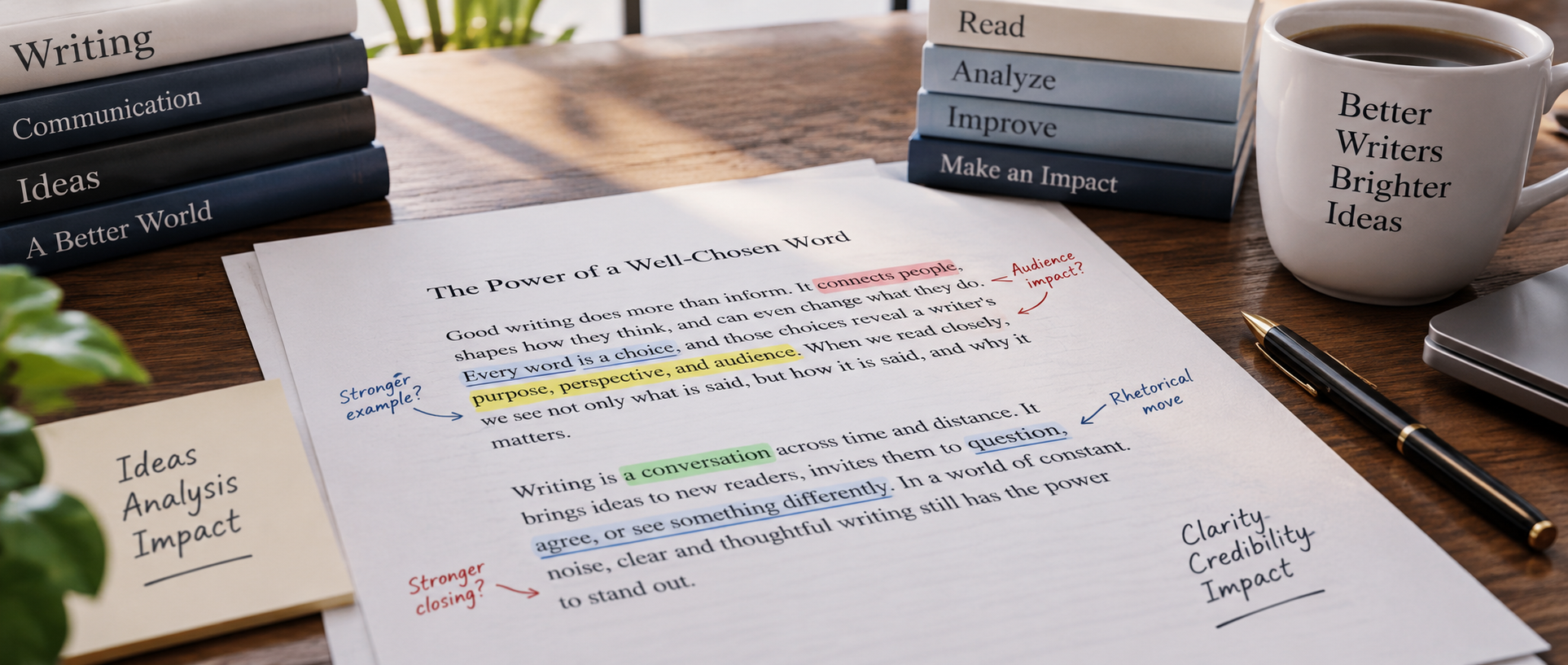
Use tools, writing analysis, and learning resources for reports, business communication, public writing, and academic work. Producing the text is only one part. The greater challenge is making it clear, credible, and effective.
The decisions behind the writing
Explore Writer’s Decisions, Reader’s Psychology, Critical Reading, Writer’s Fingerprints, and Persuasive Moves. Examine authorship attribution, stylometry, ethos, logos, pathos, and other writing choices through real passages and examples.